
Wildcards in the element identifier
Since the EL level of an address itself can comprise several parts, the following extension applies here: An "*" addresses all the elements of this and all lower levels. An asterisk followed by a period ("*.") addresses exactly one level. The depth of the levels is determined by the periods ("."). To skip levels, use a period and asterisks , e.g. (".**"). This applies provided that the levels are within the element hierarchy. Therefore, specify at least one asterisk "*" for the DP level or include a period before the first "**".
Example
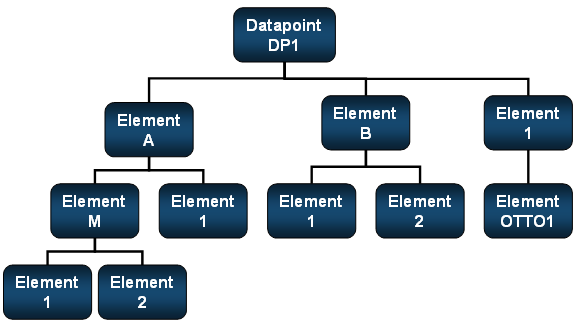
The naming convention of WinCC OA stipulates that elements of an array (that is, the structure of a particular type) are numbered from 1 to n. Other names are not taken into account since these elements are always named "array[index]" by the system. This also influences the resolution of the wildcards and prevents the correct detection of the elements if the naming conventions are not adhered to.
Table: Expression and Results for the above-mentioned Example
| Expression | Result(s) |
| DP1.A.M.* | DP1.A.M.1, DP1.A.M.2 |
| DP1.*.1 | DP1.A.1, DP1.B.1 |
| DP1.*1 | DP1.1 |
| DP1.**1 | DP1.A.M.1, DP1.A.1, DP1.B.1, DP1.1, DP1.1.OTTO1 |
| DP1.**.1 | DP1.A.M.1, DP1.A.1, DP1.B.1, DP1.1 |
| DP1.{A,B}.* | DP1.A.M, DP1.A.1, DP1.B.1, DP1.B.2 |
| DP1.*.*.1 | DP1.A.M.1 |
| DP1.* | DP1.A, DP1.B, DP1.1 |
| DP1.** | DP1., DP1.A, DP1.A.M, DP1.A.M.1, DP1.A.M.2, DP1.A.1, DP1.B, DP1.B.1, DP1.B.2, DP1.1, DP1.1.OTTO1 |
| DP1.: | DP1. |
| DP1.** |
DP1.1.OTTO1 DP1.B.1 DP1.B.2 DP1.A.1 DP1.A.M.1 DP1.A.M.2 |