
MS SQL schema
This document describes the static database objects created by schema.sql.
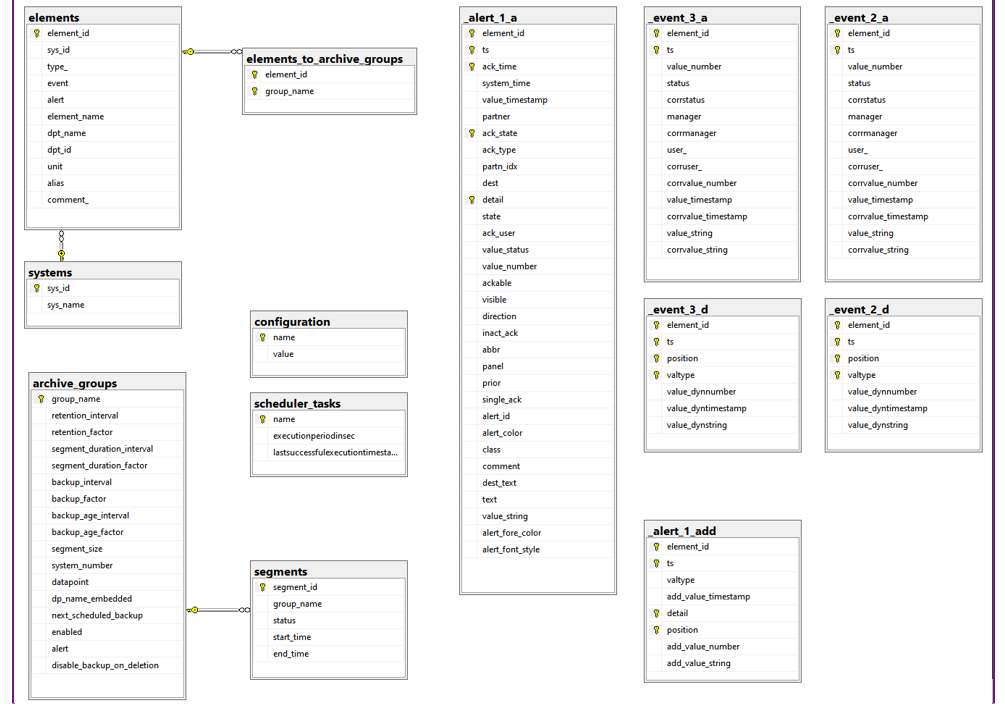
archive_groups
The archive_groups table contains information about the backend's archive groups.
Columns
| Column | Type | Description |
|---|---|---|
| group_name | nvarchar(50) | archive group name (format: systemName:groupName) |
| retention_interval | int | unit of retention period (0:minutes,1:hours,2:days,3:weeks,4:months,5:years) |
| retention_factor | int | retention time in units of retention_interval |
| segment_duration_interval | int | unit of segment duration (0:minutes,1:hours,2:days,3:weeks,4:months,5:years) |
| segment_duration_factor | int | segment duration (factor in units of segment_duration_interval) |
| backup_interval | int | unit of backup interval (1:hours,2:days,3:weeks,4:months,5:years) |
| backup_factor | int | backup interval time |
| backup_age_interval | int | unit of backup age (0:minutes,1:hours,2:days,3:weeks) |
| backup_age_factor | int | age of segments that should be backed up |
| segment_size | int | segment size (unit depends on backend settings) |
| system_number | int | group system id number |
| datapoint | int | group datapoint id |
| dp_name_embedded | nvarchar(4000) | group DPE name |
| next_scheduled_backup | bigint | time of next planned backup (epoch in ns/ms depending on backend) |
| enabled | bit | is archive group enabled? (default 1) |
| alert | bit | is this alerts archive group? (default 0) |
| disable_backup_on_deletion | bit | should backup segments whose retention time was exceeded? (default 0) |
Constraints / Indexes
- PK_archive_groups: PRIMARY KEY (group_name)
configuration
The configuration table is used as a key-value store for internal parameters that are defined when the DB is created.
Columns
| Column | Type | Description |
|---|---|---|
| name | nvarchar(50) | Parameter name |
| value | nvarchar(4000) | Parameter value |
Constraints / Indexes
- PK_configuration: PRIMARY KEY (name)
elements
The elements table contains information on the datapoint elements whose values must be read, written, and archived.
Columns
| Column | Type | Description |
|---|---|---|
| element_id | bigint | ID of DPE |
| sys_id | bigint | System ID |
| type_ | bigint | Element type (integer, float, etc.) |
| event | bit | Is this element an event? (default 0) |
| alert | bit | Is this element an alert? (default 0) |
| element_name | nvarchar(4000) | DPE name |
| dpt_name | nvarchar(4000) | Datapoint type name |
| dpt_id | int | Datapoint type ID |
| unit | nvarchar(4000) | Value unit |
| alias | nvarchar(4000) | Alias text |
| comment_ | nvarchar(4000) | Comment |
Constraints / Indexes
- PK_elements: PRIMARY KEY (element_id)
- FK_elements_systems: FOREIGN KEY (sys_id) REFERENCES systems(sys_id)
- element_name_idx: NONCLUSTERED INDEX (element_name)
elements_to_archive_groups
The elements_to_archive_groups table defines many-to-many relations between "archive groups" and "elements". This table allows storing cross-references for multiple archive groups.
Columns
| Column | Type | Description |
|---|---|---|
| element_id | bigint | Element ID |
| group_name | nvarchar(50) | Archive group name |
Constraints / Indexes
- PK_elements_to_archive_groups: PRIMARY KEY (element_id, group_name)
- FK_to_elements: FOREIGN KEY (element_id) REFERENCES elements(element_id) ON DELETE CASCADE
scheduler_tasks
The table scheduler_tasks contains information about the last successful execution of periodic tasks and their execution period in seconds.
Columns
| Column | Type | Description |
|---|---|---|
| name | nvarchar(150) | Task name |
| executionperiodinsec | bigint | How often the task should be executed (seconds) |
| lastsuccessfulexecutiontimestamp | bigint | Timestamp when the task was last successfully executed |
Constraints / Indexes
- PK_scheduler_tasks: PRIMARY KEY (name)
segments
The segments table contains a list of segments for archive groups.
The segment ID value is used in the name of the respective table that contains the historical data for this segment.
Columns
| Column | Type | Description |
|---|---|---|
| segment_id | bigint | Segment ID number (IDENTITY) |
| group_name | nvarchar(50) | Archive group name |
| status | int | Segment status (0: current, 1: online, 2: onlineAndBackuped, 3: offlineAndBackuped, 4: deleted, 5: restored) |
| start_time | bigint | Segment start time |
| end_time | bigint | Segment end time |
Constraints / Indexes
- PK_segments: PRIMARY KEY (segment_id)
- UK_group_name_start_time: UNIQUE (group_name, start_time)
- FK_to_archive_groups: FOREIGN KEY (group_name) REFERENCES archive_groups(group_name) ON DELETE CASCADE
systems
The systems table contains information on the systems of the WinCC OA project.
Columns
| Column | Type | Description |
|---|---|---|
| sys_id | bigint | System ID number |
| sys_name | nvarchar(4000) | System display name |
Constraints / Indexes
- PK_systems: PRIMARY KEY (sys_id)
_event_*_a
Stores simple (non-dyn) event values. These tables are created dynamically as part of the archiving/segmentation process.
Columns
| Column | Type | Description |
|---|---|---|
| element_id | bigint | DP element ID |
| ts | bigint | Event creation timestamp |
| value_number | float | Numeric value |
| status | bigint | Status bits |
| corrstatus | bigint | Correction status bits |
| manager | int | Manager which set the value |
| corrmanager | int | Manager which set the correction value |
| user_ | int | Logged-in user when the value was set |
| corruser_ | int | Logged-in user when the correction value was set |
| corrvalue_number | float | Correction numeric value |
| value_timestamp | bigint | Timestamp-type value |
| corrvalue_timestamp | bigint | Correction timestamp-type value |
| value_string | nvarchar(max) | String value |
| corrvalue_string | nvarchar(max) | Correction string value |
Constraints / Indexes
- PRIMARY KEY (element_id, ts)
_event_*_d
Stores events for dyn values. These tables are created dynamically as part of the archiving/segmentation process.
Columns
| Column | Type | Description |
|---|---|---|
| element_id | bigint | DP element ID |
| ts | bigint | Event creation timestamp |
| position | int | Position within the dyn value |
| valtype | smallint | Type of stored value |
| value_dynnumber | float | Dyn numeric value |
| value_dyntimestamp | bigint | Dyn timestamp value |
| value_dynstring | nvarchar(max) | Dyn string value |
Constraints / Indexes
- PRIMARY KEY (element_id, ts, position, valtype)
_alert_*_a
Stores alert values. These tables are created dynamically as part of the archiving/segmentation process.
Columns
| Column | Type | Description |
|---|---|---|
| element_id | bigint | DP element ID |
| ts | bigint | Alert creation timestamp |
| ack_time | bigint | Acknowledgement time |
| system_time | bigint | Time when the alert was received by the system |
| value_timestamp | bigint | Value of timestamp type |
| partner | bigint | Alert time for the partner |
| ack_state | int | Identifies how the alert was acknowledged |
| ack_type | int | Type of acknowledgement |
| partn_idx | int | Alert index for the alert partner |
| dest | int | Current alert range |
| detail | int | Detail ID / number |
| state | int | Status bits |
| ack_user | int | User who acknowledged the alert |
| value_status | bigint | Status of the value that triggered the alert |
| value_number | float | Numeric value |
| ackable | bit | Is the alert acknowledgeable? |
| visible | bit | Is the alert visible? |
| direction | bit | True for CAME, false for WENT |
| inact_ack | bit | Inactive alerts must be acknowledged |
| abbr | nvarchar(max) | Short sign of priority |
| panel | nvarchar(max) | Panel for cross-selection |
| prior | int | Priority |
| single_ack | bit | Did a single acknowledgement occur? |
| alert_id | nvarchar(max) | ID for multi-instance alarm |
| alert_color | nvarchar(max) | Background color |
| class | nvarchar(max) | Alert class |
| comment | nvarchar(max) | User comment |
| dest_text | nvarchar(max) | Text for current alert range |
| text | nvarchar(max) | Status text for the range |
| value_string | nvarchar(max) | String value |
| alert_fore_color | nvarchar(max) | Foreground color |
| alert_font_style | nvarchar(max) | Font style |
Constraints / Indexes
- PRIMARY KEY (element_id, ts, detail)
_alert_*_add
Stores additional values for alerts. These tables are created dynamically as part of the archiving/segmentation process.
Columns
| Column | Type | Description |
|---|---|---|
| element_id | bigint | DP element ID |
| ts | bigint | Alert creation timestamp |
| valtype | bigint | Type of stored value |
| add_value_timestamp | bigint | Timestamp-type additional value |
| detail | int | Detail ID / number |
| position | int | Position within the dyn value |
| add_value_number | float | Numeric additional value |
| add_value_string | nvarchar(max) | String additional value |
Constraints / Indexes
- PRIMARY KEY (element_id, ts, detail, position)
view_events_%system_number%
The view view_events_%system_number% contains the union of all event
segment tables with the statuses CURRENT, ONLINE,
ONLINE AND BACKUPED and RESTORED.
segments.status) typically maps these to
0, 1, 2, 5. Columns
| Column | Type | Description |
|---|---|---|
| element_id | bigint | DP element ID |
| element_name | nvarchar(max) | DP element name |
| sys_id | bigint | System ID |
| ts | bigint | Event creation timestamp |
| position | int | Position within the dyn value |
| value_number | float | Numeric value |
| status | bigint | Status bits |
| corrstatus | bigint | Correction status bits |
| manager | int | Manager which set the value |
| corrmanager | int | Manager which set the correction value |
| user_ | int | Logged-in user when a value was set |
| corruser_ | int | Logged-in user when a correction value was set |
| corrvalue_number | float | Correction numeric value |
| value_timestamp | bigint | Timestamp-type value |
| corrvalue_timestamp | bigint | Correction timestamp-type value |
| value_string | nvarchar(max) | String value |
| corrvalue_string | nvarchar(max) | Correction string value |
| valtype | smallint | Type of stored value |
| value_dynnumber | float | Dyn numeric value |
| value_dyntimestamp | bigint | Dyn timestamp value |
| value_dynstring | nvarchar(max) | Dyn string value |
view_alarms_%system_number%
The view view_alarms_%system_number% contains the union of all alert
segment tables with the statuses ONLINE, CURRENT,
ONLINE AND BACKUPED, and RESTORED.
view_alarms_%system_number% contains the actual
system number.Columns
| Column | Type | Description |
|---|---|---|
| element_name | nvarchar(max) | DP element name |
| element_id | bigint | DP element ID |
| sys_id | bigint | System ID |
| ts | bigint | Alert creation time |
| ack_time | bigint | Acknowledgement time |
| system_time | bigint | Time the alert was received by the system |
| value_timestamp | bigint | Value of timestamp type |
| partner | bigint | Alert time for the partner |
| ack_state | int | Identifies how the alert was acknowledged |
| ack_type | int | Type of acknowledgement |
| partn_idx | int | Alert index for the alert partner |
| dest | int | Current alert range |
| detail | int | Detail ID / number |
| state | int | Status bits |
| ack_user | int | User who acknowledged the alert |
| value_status | bigint | Status of the value that triggered the alert |
| value_number | float | Numeric value |
| ackable | bit | Is the alert acknowledgeable? |
| visible | bit | Is the alert visible? |
| direction | bit | True for CAME, false for WENT |
| inact_ack | bit | Inactive alerts must be acknowledged |
| abbr | nvarchar(max) | Short sign of the priority |
| panel | nvarchar(max) | Panel for cross-selection |
| prior | int | Priority |
| single_ack | bit | Did a single acknowledgement occur? |
| alert_id | nvarchar(max) | ID for multi-instance alert |
| alert_color | nvarchar(max) | Background color |
| class | nvarchar(max) | Alert class |
| comment | nvarchar(max) | User comment |
| dest_text | nvarchar(max) | Text for current alert range |
| text | nvarchar(max) | Status text for the range |
| value_string | nvarchar(max) | String value |
| alert_fore_color | nvarchar(max) | Foreground color |
| alert_font_style | nvarchar(max) | Font style |
| valtype | bigint | Type of stored (dyn) value |
| position | int | Position within the dyn value |
| add_value_number | float | Numeric additional value |
| add_value_string | nvarchar(max) | String additional value |
| add_value_timestamp | bigint | Timestamp-type additional value |